How the Internet Changes What We Believe
You’re right. That version tells the reader what happens in the episode instead of giving them a reason to listen. The introduction should establish the problem, sharpen it, and then hand the question to the episode.
For most of human history, becoming a fanatic required some effort.
A person generally had to go somewhere. Join something. Find the meetings, read the literature, seek out the people who shared the belief. Even conspiracy theories required a certain amount of initiative. The believer had to find the books, subscribe to the newsletters, or know which guy at the gun show had the mimeographed pages under the table.
Now the meeting is in your pocket.



The modern internet has given almost everyone access to more information than the greatest libraries of previous generations could have contained. It has also created something those libraries could never provide: an information environment built specifically for the individual using it.
Watch one video and another appears. Click one story and five related stories follow. Stop scrolling for a few seconds over something that makes you angry, frightened, vindicated, or curious, and the machinery takes note.
Before long, the internet can begin to look remarkably like the world as you already believe it to be.
That presents a problem far more serious than “fake news.”
Human beings have always been capable of believing things that aren’t true. They have always sought confirmation, followed crowds, distrusted outsiders, and confused confidence with knowledge. What has changed is the speed and scale at which those tendencies can now be reinforced.
A mistaken idea once had to survive encounters with people who disagreed with it. Today it is possible to spend hours surrounded by thousands of people who confirm it.
And the most dangerous part may be that nobody has to feel manipulated.
The experience feels like discovery, “I’m just asking questions…”
The person scrolling through the feed believes he is gathering evidence. He is doing research. He is finding people who finally understand what everyone else refuses to see. Each new post seems to confirm the last one until the accumulation itself begins to feel like proof.
Eventually, contrary evidence can become strangely powerless. Facts no longer stand or fall on their own merits. They are judged according to who presents them. An argument from the wrong political faction, institution, religion, newspaper, scientist, or social group can be rejected before it is even considered.
At some point, that stops looking like ordinary disagreement and it begins looking remarkably like a cult. That raises an uncomfortable question for anyone who believes a free society depends upon citizens capable of reasoning for themselves.
What happens when the cult no longer needs a compound because everyone carries one in his pocket?
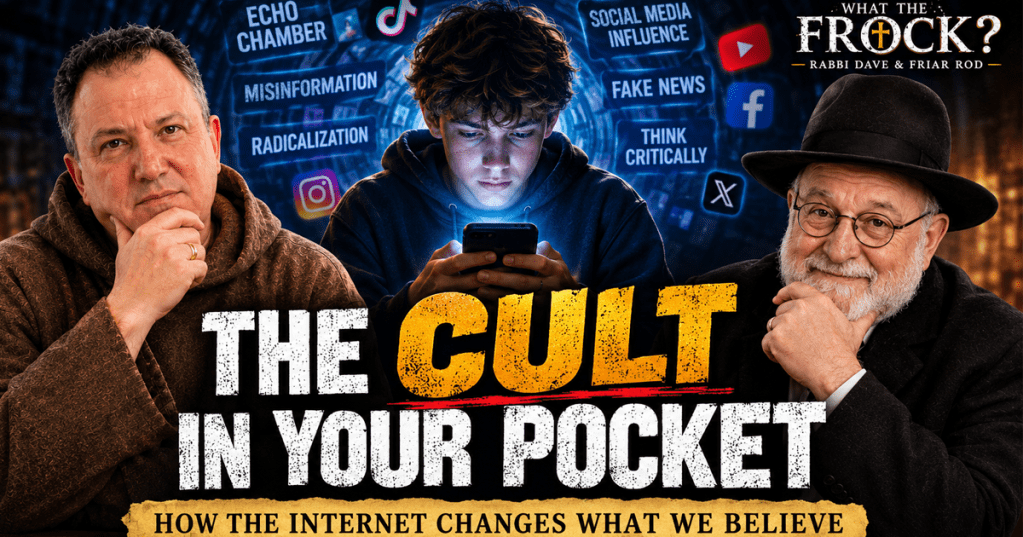
This week on What The Frock?, Rabbi Dave and Friar Rod confront that question, and an even more difficult one:
How do we keep the people we love from disappearing into it?





 What The Frock
Leave a comment