Accountability is one of those words everyone likes until it arrives at their own front door...
We expect it from politicians, corporations, journalists, religious leaders, and increasingly from the people building the technology that is becoming woven into everyday life. Yet the more authority becomes decentralized, the harder a simple question becomes to answer: Who actually has the power to say, “No, you cannot do that”?
That question takes Rabbi Dave and Friar Rod into some remarkably strange territory on this edition of What the Frock?
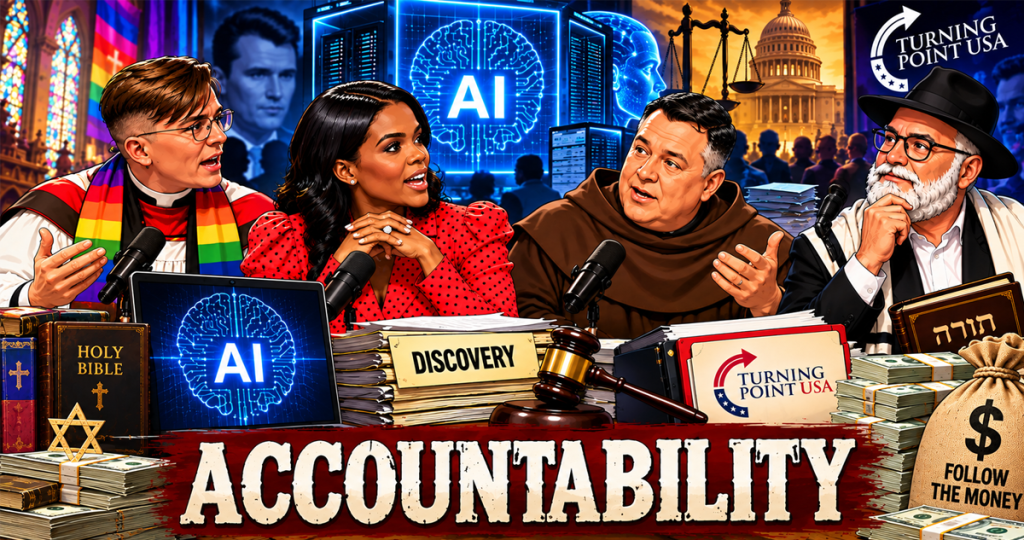
Consider religion. A priest can stand before a congregation and make extraordinary theological claims about God, gender, Jesus, and the Resurrection. Modern churches often speak proudly about inclusion and individual interpretation, but Christianity also has scripture, doctrine, tradition, and institutional authority. At some point, interpretation either has boundaries or it doesn’t. If those boundaries exist, who enforces them? And what happens when challenging a theological claim is itself treated as unacceptable?
Then there is the strange modern world of independent media, where enormous audiences can be assembled without editors, producers, network executives, or traditional institutional restraints. Candace Owens has demonstrated just how powerful that independence can be while pursuing her questions and allegations surrounding Charlie Kirk and Turning Point USA. But independence from gatekeepers is not independence from accountability. Courts have their own mechanism for sorting allegation from evidence, and it has a wonderfully ominous name:
Discovery.
Suddenly, “I’m just asking questions” encounters another question: What do you have to support them?
And then there is artificial intelligence.
AI may eventually make the other questions look easy. Governments want to regulate it. Technology companies want to develop it. Activists want access to it. Investors want profits from it. Ordinary people increasingly depend upon systems whose inner workings they cannot see and whose decisions they may not understand.
So who is accountable when AI gets something wrong? The programmer? The company? The user? The government that regulates it? The government that fails to regulate it?
Perhaps there is another question worth asking first.
Who is paying for all of this?
Because whether we’re talking about pulpits, podcasts, courtrooms, governments, or artificial intelligence, authority rarely exists in a vacuum. Somewhere behind it are institutions, incentives, reputations, audiences, and money.
And once you start following those, accountability becomes a very interesting subject indeed.
This week on What the Frock?: Accountability.
One rabbi. One friar. Absolutely no supervision.





Leave a Reply