There is a theory, which is dangerous already because most theories are, that humanity crossed an important threshold sometime around the moment people stopped asking whether something was true and instead began asking whether it was entertaining.
Historians will probably argue about the exact date for centuries, assuming historians still exist and have not been replaced by a cheerful subscription service called HistoriGPT+, now featuring emotionally supportive footnotes.
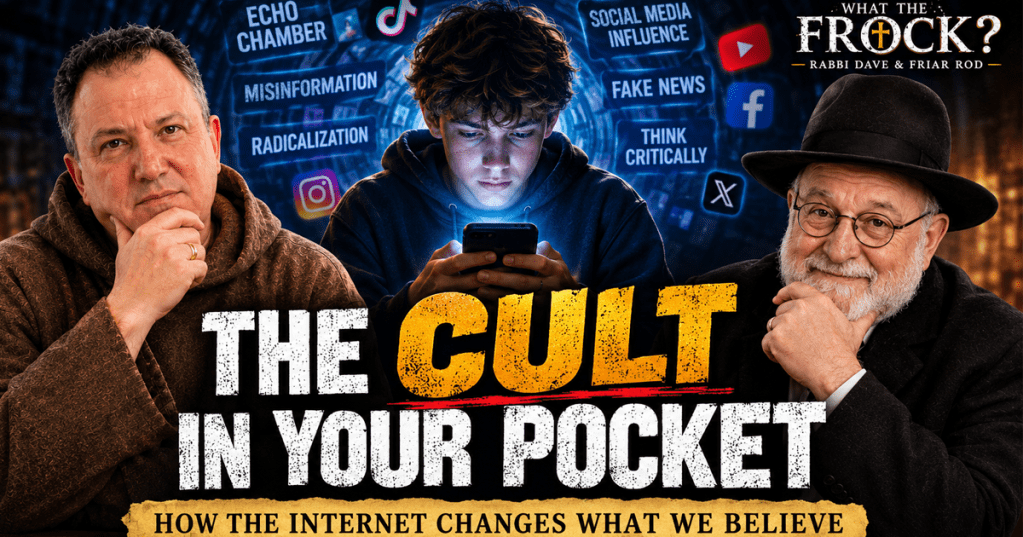
In this week’s episode of What The Frock?, Rabbi Dave and Friar Rod stumble cheerfully into the collapsing boundary between reality, technology, politics, spirituality, fireworks, and whatever it is Spencer Pratt is doing in Los Angeles. Which, to be fair, may also qualify as spirituality.
The episode begins with a perfectly reasonable question:
Can anyone still tell whether a politician actually said something, or whether an AI system generated it five minutes ago while somebody microwaved leftover pizza?
The answer, naturally, appears to be “probably not.”
Using recent AI-generated political videos and viral campaign tactics as examples, the show explores the growing realization that politics is no longer really politics at all. It is entertainment infrastructure wearing a necktie and pretending to care about zoning regulations.
Donald Trump, whatever else one thinks about him, seems to understand this instinctively. Traditional political campaigns once spent millions buying television airtime, carefully crafting thirty-second ads full of inspirational music and suspiciously diverse groups of smiling people eating salad.
Now someone with a laptop, an AI image generator, and unresolved emotional issues can produce a viral political attack video before breakfast.
The old political machine bought airtime. The new one buys attention.
These are not remotely the same thing, in much the same way that a towel is not remotely the same thing as a small confused badger.
Meanwhile, the conversation drifts, as all intelligent conversations eventually do, toward astrology.
Not because astrology makes sense, which it manifestly does not, but because human beings have always desperately wanted the universe to explain itself. People do not merely want stars. They want personalized stars. Stars that understand them. Stars that validate their life choices while gently encouraging hydration and emotional growth.
The episode wrestles with an uncomfortable realization: people rarely believe things simply because they are true. They believe things because the beliefs provide meaning, identity, comfort, tribe, or the reassuring illusion that someone somewhere is actually in charge.
Religion, astrology, internet conspiracy theories, self-help influencers, motivational TikTok shamans waving crystals under LED ring lights, the differences may be less about structure than most people would like to admit.
Of course, Rabbi Dave points out an important distinction. Traditional faith systems usually demand sacrifice, discipline, covenant, responsibility, and submission to something greater than oneself. Astrology generally tells you Mercury is retrograde and therefore none of this is your fault.
Which, frankly, is a much easier sales pitch.
Then the episode becomes genuinely unsettling.
Because if AI can already generate political propaganda tailored specifically to your emotional weaknesses, why stop there?
Why not personalized spiritual guidance? Why not machine-generated prophets? Why not AI sermons crafted specifically for your fears, desires, insecurities, and search history?
Humanity once feared false prophets. Modern civilization may eventually pay $9.99 a month for premium access to them.
And because the universe has a strange sense of humor, the episode finally arrives at fireworks.
Specifically, the growing trend of replacing traditional Fourth of July fireworks with drone shows.
Now drone shows are objectively impressive. They are cleaner, quieter, safer, environmentally friendlier, and capable of creating giant glowing eagles in the sky without terrifying every dog within three counties.
But fireworks possess something drones do not. Fireworks are primitive. That is rather the point.
They shake your chest. They smell like smoke and rebellion. They feel vaguely irresponsible in the same way democracy itself often feels vaguely irresponsible.
As Rabbi Dave observes during the discussion:
“The Fourth of July is not supposed to feel safe and optimized. It commemorates rebellion and cannon fire.”
Which may quietly be the thesis statement for the entire episode.
Because underneath the jokes, the sarcasm, the AI nightmares, the astrology discussions, and the synchronized battery management jokes, this episode asks a very old question:
What parts of being human are we willing to trade away for convenience?
And perhaps more importantly: Who exactly is making that decision while the rest of us are distracted watching fake videos on the internet?
As always, the answer is probably someone selling advertising.



Leave a comment